A standalone story
How Ferguson tractors reached the South Pole in 1958
They sighted the Pole at 8 p.m. on 3 January 1958, sent the code word “Rhubarb,” and went to sleep. The next day, at 12.30 p.m., a party of New Zealanders rolled into the South Pole station in converted farm tractors with windshields but no roofs.
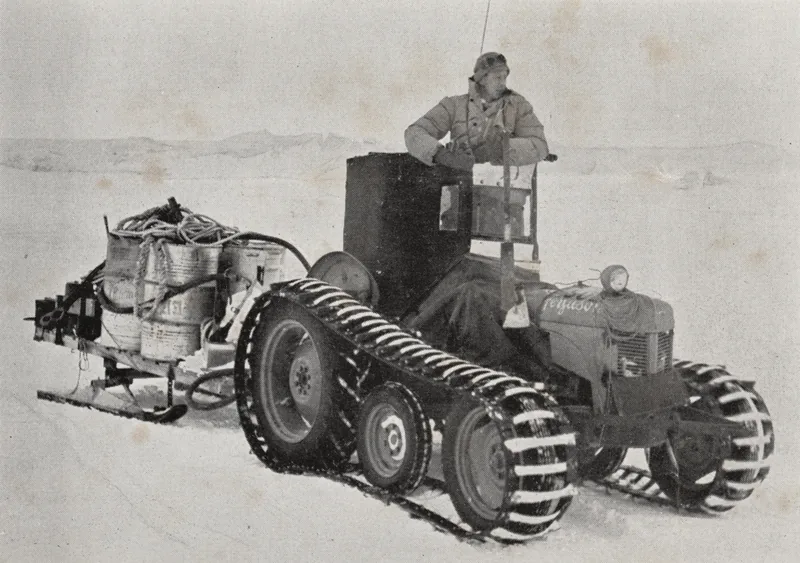
NZ History records that Sir Edmund Hillary’s New Zealand party reached the South Pole on 4 January 1958. They were the first to do so overland since Robert Falcon Scott in 1912, and the first to reach it in motor vehicles. [source][source]
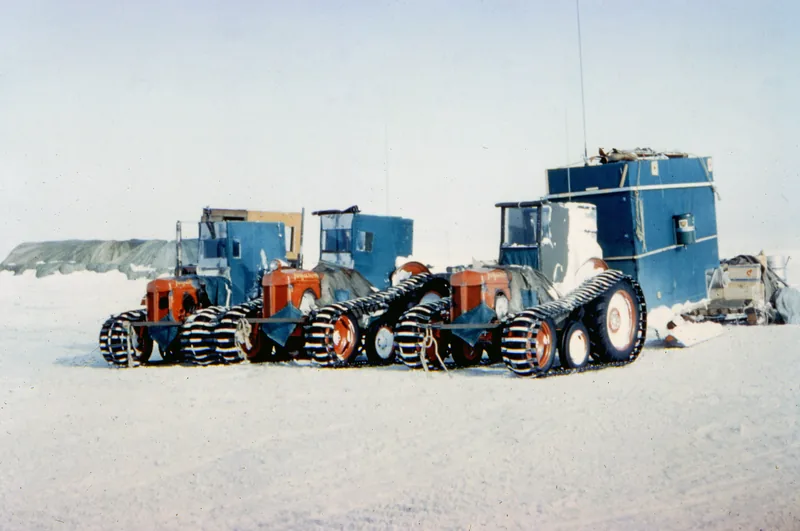
The more detailed official page, “Arrival at the Pole by tractor,” says the party completed the journey in three converted Ferguson tractors with “windshields but no roofs.” Hillary’s official biographer, Alexa Johnston, has likened that to driving “across Antarctica in convertibles.” Two sledges and a caboose — “essentially a caravan on skis” — containing bunks, cooking and radio facilities, also survived the journey. [source]
The dash, and why it was controversial
The New Zealanders were not, originally, supposed to be racing for the Pole. They were the Ross Sea support party of the Commonwealth Trans-Antarctic Expedition, whose overall commander was Dr Vivian Fuchs. Their job was to help establish Scott Base, and to lay food and fuel depots for Fuchs’s crossing party. [source][source]
NZ History says the southern party set out from Scott Base on 14 October 1957 to lay those depots. The final “dash to the pole” began at 8.30 p.m. on 20 December. At that point, the same page names the party as Hillary, Murray Ellis, Peter Mulgrew, Jim Bates and Derek Wright. [source]
It was, the official history is frank, a controversial decision. Hillary went on “without the express permission of the TAE, and against the instructions of the committee co-ordinating New Zealand’s contribution.” In his autobiography Nothing venture, nothing win, quoted by NZ History, he wrote: “I continued as though the exchange of messages had never occurred … It was becoming clear to me that a supporting role was not my particular strength.” [source][source]
After 14 days battling sastrugi — wind-eroded snow ridges — soft snow and crevasses, they sighted the Pole at 8 p.m. on 3 January 1958. They were exhausted, “having slept for only a few hours at a time since leaving Scott Base.” They sent the code word “Rhubarb” to show they had the Pole in sight, slept, and arrived at 12.30 p.m. the next day. [source]
Where the official accounts do not quite match
This is one of those stories in which the official sources are excellent, and not identical. The detailed NZ History page names five men on the dash and calls the machines “Ferguson tractors.” A shorter NZ History page says “Hillary and his four-man team set out for the Pole on modified Massey Ferguson tractors,” and that Hillary reached the Pole 16 days ahead of Fuchs. [source][source]
Antarctica New Zealand’s account of the expedition lists the Southern Tractor Party as Hillary, Murray Ellis, Jim Bates, Peter Mulgrew and Derrick Wright — the same five names, with Wright spelled differently — and mentions three Fergusons and a Weasel, and 10 tonnes of cargo. It records Fuchs at the Pole on 19 January, and the crossing as 3,473 kilometres in 99 days. [source] Those last figures describe Fuchs’s trans-Antarctic crossing, not Hillary’s journey from Scott Base, and should not be borrowed as a mileage for the tractors’ dash.
This site does not flatten those differences. It prefers “Ferguson TE20” when describing the machines, because the period photographs show Ferguson tractors and the more detailed official narrative says Ferguson, and it notes that later writing often says Massey Ferguson. It spells Wright as Derek when citing the NZ History arrival page, and notes Antarctica New Zealand’s Derrick.
What happened when Fuchs arrived
Speculation of a rift followed Hillary’s arrival. NZ History records that when Fuchs met Hillary at the Pole on 20 January, “there was no evidence of animosity between the pair — Fuchs’ first words to Hillary were ‘Damned glad to see you, Ed’.” In the days that followed, Fuchs called on Hillary’s knowledge of the terrain between the Pole and Scott Base. Fuchs’s party arrived at Scott Base on 2 March 1958. [source] Antarctica New Zealand dates Fuchs at the Pole on 19 January. [source] The one-day difference is left standing.
In a 2003 interview with Time, quoted by NZ History, Hillary was asked whether the Antarctic had been harder than Everest. “Oh, no,” he said. “It was different in many different ways. The problems of snow and ice were similar, but on a big mountain like Everest, there were more immediate dangers.” [source]
The grey Fergie was already a farm classic. After January 1958 it was also, briefly, a polar exploration vehicle — open to the wind, pulling fuel on a sledge, carrying a code word as modest as rhubarb. The machine itself is a Coventry story. This one belongs to the ice.
Enjoyed the tractor?
No pop-ups. No intrusive advertising. Just interesting stuff. A little support helps the next farmyard site get built.