Sourced facts
Facts, kept in their places
Each of these is a separate official record. They are not subtracted from one another, and they do not all describe the same country or the same kind of return.
- MERL’s TE20 label (object 80/68) says production was switched to England in 1946, under the Ferguson name, and that the result was the classic ‘grey Fergie’. [source]
- The same label says the hydraulic three-point linkage for attaching implements remains the basis of modern tractor design. [source]
- MERL’s Model Farming gallery guide says TE stood for Tractor England. [source]
- MERL’s catalogue for a Ferguson demonstration model (2014/16/1-8, circa 1949–1951) says the clockwork model was designed to show how the three-point linkage worked, without a full-scale demonstration. [source]
- Nebraska Tractor Test 392, “Ferguson Model TE-20,” is dated January 1948 in the University of Nebraska–Lincoln Digital Commons record. The official abstract describes uncorrected results on stock machines. This site does not quote later unofficial horsepower figures for that test. [source]
- In the Commons on 20 April 1939, Sir R. Dorman-Smith said an inquiry in September 1937 “indicated” about 43,000 tractors on farms in England and Wales. That was an inquiry, not a named census total, and it is an England-and-Wales figure. [source]
- In the Commons on 23 March 1950, Mr T. Williams gave United Kingdom figures: estimated about 55,000 agricultural tractors in 1939; a census of about 245,000 in January 1948; and an estimate of about 300,000 in March 1950. A previous contradictory figure was attributed by the Minister to a clerical error and is not used here. [source]
Working scenes from elsewhere
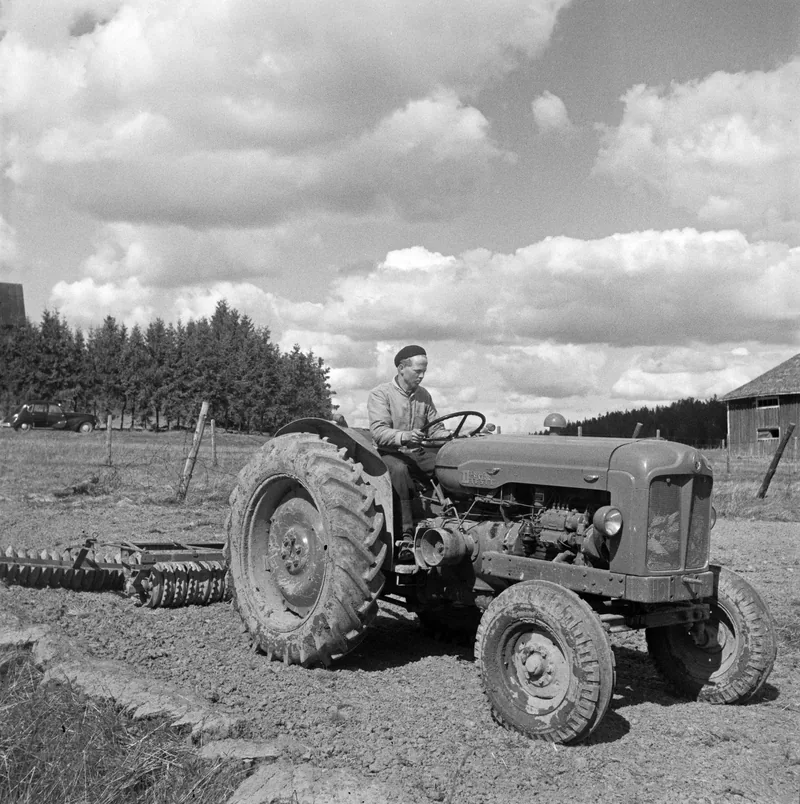
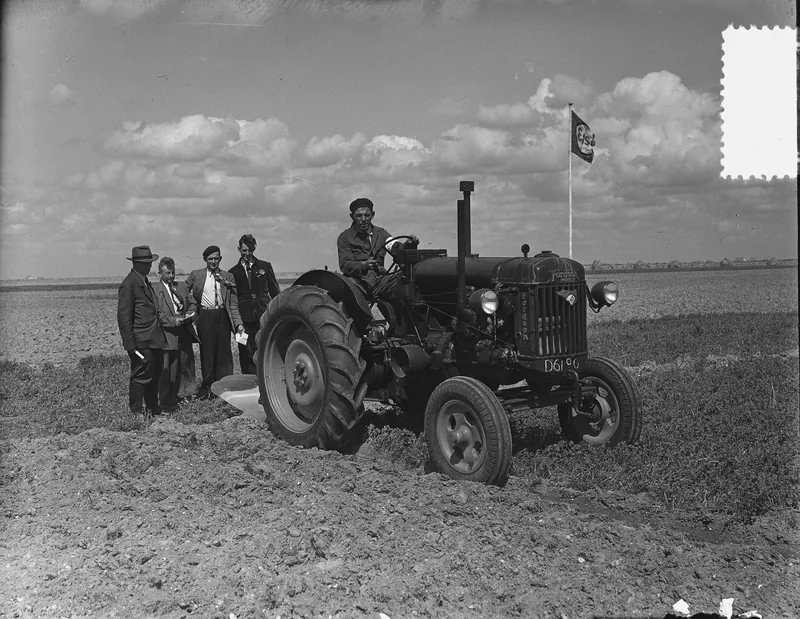
The photographs below are genuine historical ploughing scenes. They are not British farms, and the tractors in them are not identified here as Ferguson TE20s.
Enjoyed the tractor?
No pop-ups. No intrusive advertising. Just interesting stuff. A little support helps the next farmyard site get built.