History
The story of the farm tractor
The farm tractor did not arrive fully formed. It began as a light petrol motor in a Bedfordshire yard, spent years as a machine that merely pulled, and was only later transformed — in official museum wording — from a “mere mechanical horse” into a field machine that could pick up its own implements.
A light petrol motor, 1902
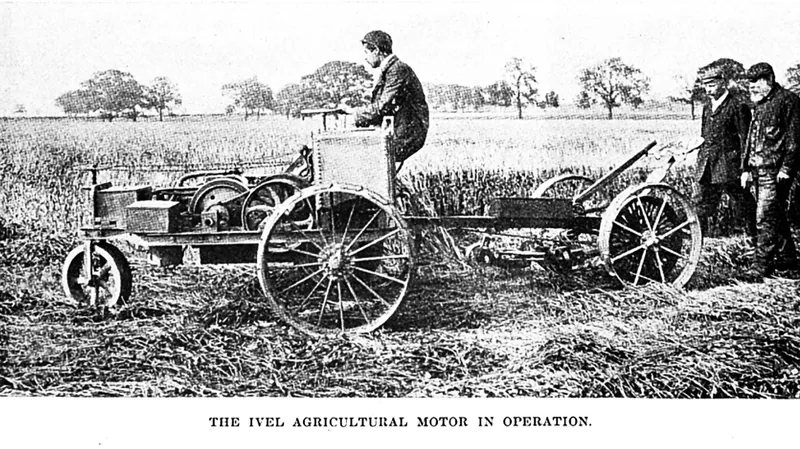
The Science Museum Group holds an Ivel agricultural tractor of 1902, designed by Daniel Albone at Biggleswade. The museum describes it as “believed to be the first ‘production’ tractor built by Ivel, and the first British internal combustion engine powered light agricultural tractor.” [source]
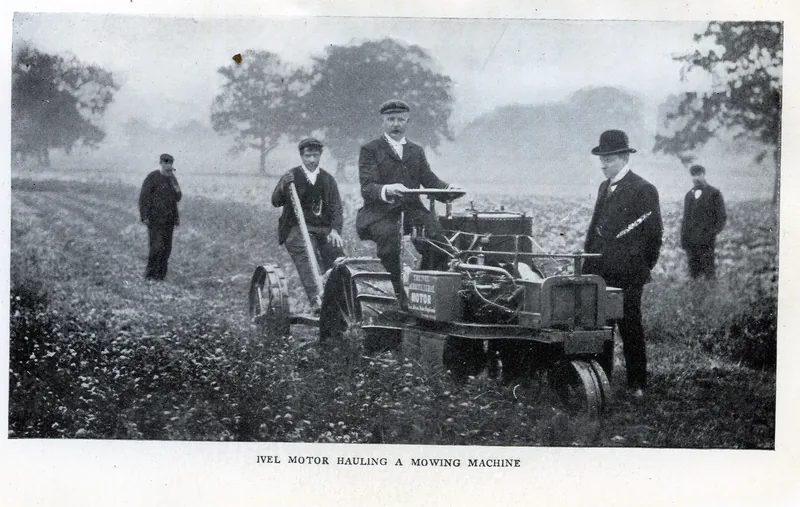
That wording is careful, and so is this page. The Ivel was not “the world’s first tractor,” and the museum does not say it was. It was a light British petrol machine, early enough to be news in motoring papers — Motor Age published a picture of an Ivel on 14 August 1902 — and early enough to be shown hauling a mowing machine in R. J. Mecredy’s The Motor Book in 1904.
From steam in the field to a tractor in the yard
Before a light petrol tractor could look obvious, heavy work on the land was often done by steam. That is a different machine, with a different culture, and it has its own sister site: traction-engines.farmyard.im. The tractor did not so much decorate that story as replace a large part of it.
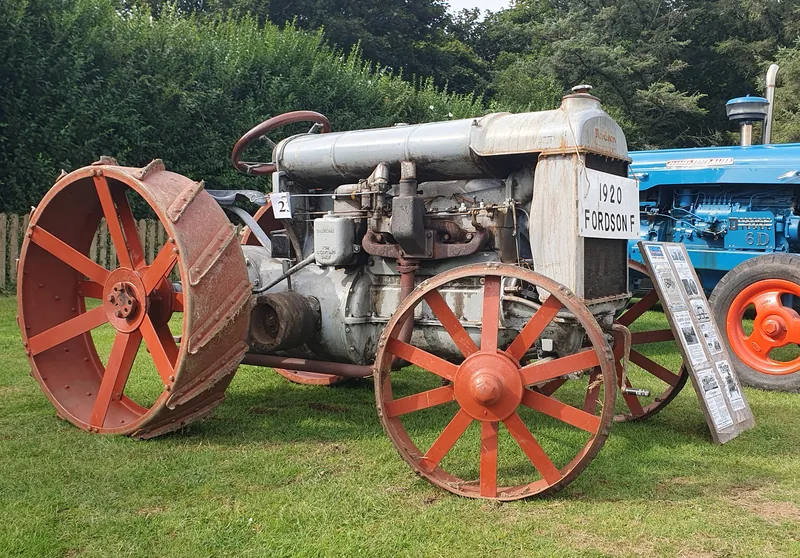
Mass-produced petrol tractors then made the change visible in almost every landscape. A surviving 1920 Fordson, photographed much later at a Cornish rally, stands in here as a reminder of that type — a later photograph of an early machine, not a 1920 snapshot. The Fordson name will come back: in 1959, a firm in Essex would join two later Fordsons together and call the result the Dual Drive.
Harry Ferguson’s long argument with the hitch
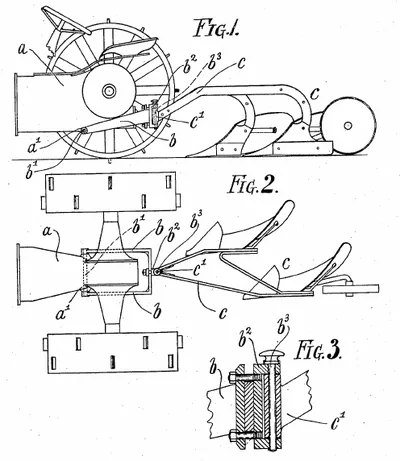
Harry Ferguson, whom the Museum of English Rural Life describes as “an inventor and engineer from Northern Ireland,” spent years on the problem of how a tractor should attach to the thing it was pulling. [source] A United States patent in his name, 1,379,399, dated 24 May 1921, is an early hitch design — a historical drawing, not a workshop diagram of the later hydraulic three-point linkage. [source]
Ulster Transport Museum, part of National Museums NI, records that the Ferguson Black, built in 1933 in Northern Ireland, was the first to fully incorporate the Ferguson System. [source] MERL’s TE20 label then gives the production path that followed: Ferguson had his tractor made first by David Brown in 1936, and by Ford in America from 1939 to 1946. [source]
Between those dates sits one of the stranger bargains in industrial history: a handshake, in the autumn of 1938, between Ferguson and Henry Ford. That story, and the $9,250,000 settlement that closed it in 1952, is told in the discoveries cabinet. [source][source]
Tractor England, 1946
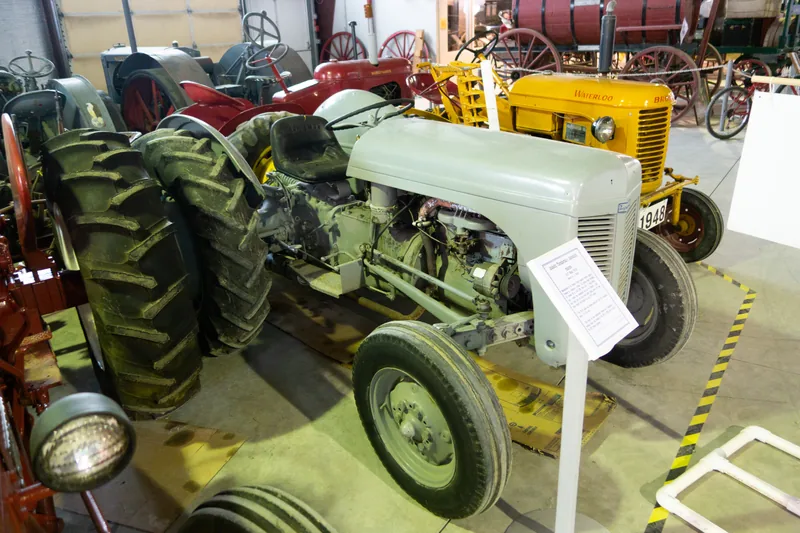
MERL’s label says production was switched to England in 1946, under the Ferguson name, and that the result was the classic ‘grey Fergie’, the TE20. [source] A MERL gallery guide for the Model Farming display, standing in front of that tractor, says “TE stood for Tractor England (MERL 80/68).” [source]
The museum’s catalogue description of the same object adds that it was probably manufactured in 1948, built by the Standard Motor Company at Banner Lane, Coventry, with a Continental Motors engine imported from Detroit because the plant was not then equipped to build engines. [source]
By then the tractor had become numerous enough to show up in Parliament. In the Commons on 23 March 1950, Mr T. Williams gave United Kingdom figures: about 55,000 agricultural tractors estimated in 1939, a census of about 245,000 in January 1948, and an estimate of about 300,000 in March 1950. [source] The fact file keeps those totals in their own geography, separate from an earlier England-and-Wales inquiry figure.
Other roads, taken and not taken
Not every important tractor was a Fergie. In Germany, the Lanz Bulldog — the Science Museum Group describes a c.1930 example as a 24-horsepower single-cylinder hot-bulb machine — would run on crude oil, tar oil, spirit, vegetable oil and other fuels, a design born of a post-war shortage. Production, the museum says, evolved until 1962, and Marshall of Gainsborough built a related British version. [source]
In Essex, Ernest Doe launched the Dual Drive in 1959, known as the Doe Triple-D: two Fordson Super Majors, minus their front wheels, with a turntable between them. The firm’s own history says that at 100 horsepower it was twice as powerful as most other tractors on the market. [source]
And in Wisconsin that same year, Allis-Chalmers demonstrated a tractor that ran on 1,008 fuel cells. It plowed alfalfa near West Allis in October 1959, and it is now in the Smithsonian — currently not on view. [source] It did not become the next grey Fergie. It remains one of the most unexpected machines in the discoveries.
Two years earlier, the little grey tractor had already had its least likely job: laying depots on the Ross Ice Shelf, and then going on, in January 1958, to the South Pole. That is a story of its own.
Keep exploring
Enjoyed the tractor?
No pop-ups. No intrusive advertising. Just interesting stuff. A little support helps the next farmyard site get built.