A cabinet of oddities
Strange, surprising and little-known tractor stories
Forgotten journeys, a handshake that became a lawsuit, two tractors joined in the middle, a machine you start with a flame, and a tractor that ran on fuel cells. Each of these has been checked against a museum, an official history, or a contemporaneous report. Legends are labelled as legends, and this cabinet does not invent what the sources do not say.
Farm tractors at the South Pole
Windshields, no roofs, and the code word “Rhubarb.”
A handshake, then $9,250,000
Ferguson, Ford, and a 1952 United Press report.
Two Fordsons joined in the middle
The Doe Dual Drive, known as the Triple-D.
A tractor you start with a flame
The Lanz Bulldog and its multi-fuel hot bulb.
1,008 cells, 20 horsepower
The Allis-Chalmers fuel-cell tractor of 1959.
Dan Albone’s Ivel, 1902
Britain’s first light petrol farm tractor.
The Black Tractor of 1933
The first machine to fully incorporate the Ferguson System.
Tractor England, Banner Lane
A Coventry car factory, and an engine from Detroit.
A clockwork demonstration
MERL’s model, built to show the linkage without a field.
A British cousin of the Bulldog
Marshall of Gainsborough, in the Science Museum’s account.
Ansel Adams and a 9N
An unlikely meeting of photographer and tractor.
Farm tractors at the South Pole
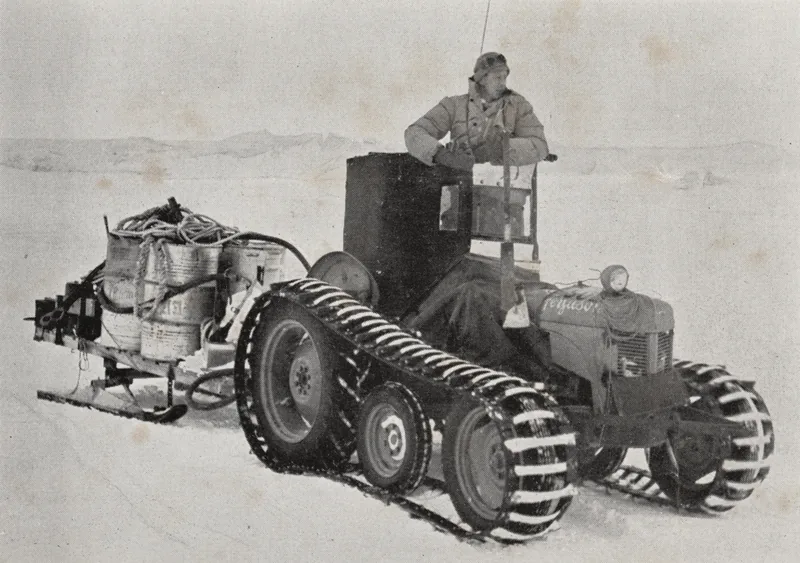
On 4 January 1958, at 12.30 p.m., Hillary’s New Zealand party arrived at the South Pole station in three converted Ferguson tractors with “windshields but no roofs.” They were the first to reach the Pole overland since Scott in 1912, and the first to do so in motor vehicles. The code word for having the Pole in sight — sent the evening before, at 8 p.m. — was “Rhubarb.” [source][source]
The full story, including the controversy of the dash and the places where official accounts disagree, is on its own page: How Ferguson tractors reached the South Pole in 1958.
A handshake at Fair Lane, and a $9,250,000 settlement
Ulster Transport Museum records a handshake agreement between Harry Ferguson and Henry Ford in the autumn of 1938. Ford, the museum says, built in excess of 306,000 tractors including the 9N and 2N. The arrangement was terminated in 1946 by Henry Ford II, with production for Ferguson continuing until June 1947. [source] The Coventry Society, writing about the same episode, places the verbal handshake at Fair Lane, Dearborn, in 1938. [source]
What followed was not a quiet ending. The Ulster account says 25,000 UK tractors were imported to the United States in 1948, and that a lawsuit was brought that year. It was settled out of court for $9.25 million in 1952. [source]
A contemporaneous United Press report, published on 10 April 1952 under the headline “Ferguson Gets $9,250,000 From Ford Co.,” says a $42,000,000 damage suit was settled for $9,250,000. [source] That is the figure this site uses. A much larger claim figure that circulates later is not in the 1952 report, and is not used here.
The Ulster museum adds that, as part of the settlement, Ford was allowed to keep using Ferguson system components except Side Suction Control. [source] That last detail is the museum’s wording, and is presented as such.
Two Fordsons joined in the middle
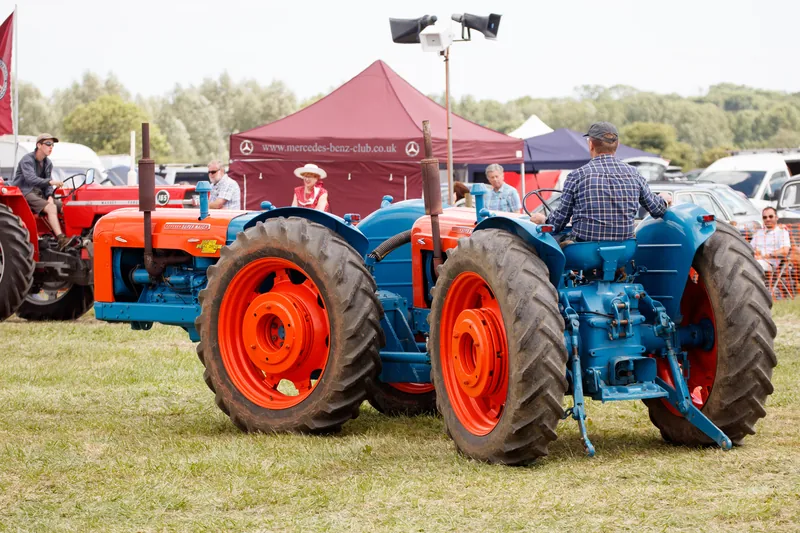
In 1959, Ernest Doe of Ulting, near Maldon in Essex, launched the Doe Dual Drive, known affectionately as the Doe Triple-D. The firm’s own history is admirably direct: it was two Fordson Super Major units with the front wheels taken off, and a turntable between them. The result was a four-wheel-drive articulated tractor. The same history says that at 100 horsepower, it was twice as powerful as most other tractors on the market. [source]
The photograph on this page is a surviving machine at the Aldham Rally in 2022, not a works picture from 1959. You can still read the idea in the later metal: two tractor bodies, nose to nose around a hinge, as if someone had solved a power problem by folding one tractor out of two.
A tractor you start with a flame
The Science Museum Group describes a Lanz Bulldog of about 1930, built by Heinrich Lanz of Mannheim, serial 110615, as a 24-horsepower single-cylinder horizontal two-stroke semi-diesel with hot-bulb ignition. [source]
The design, the museum says, came in 1920 from Dr Fritz Huber, after a post-First World War fuel shortage, and was based on the work of Herbert Akroyd Stuart. A Bulldog would run on crude oil, tar oil, spirit, vegetable oil and other fuels. Production evolved until 1962. [source]
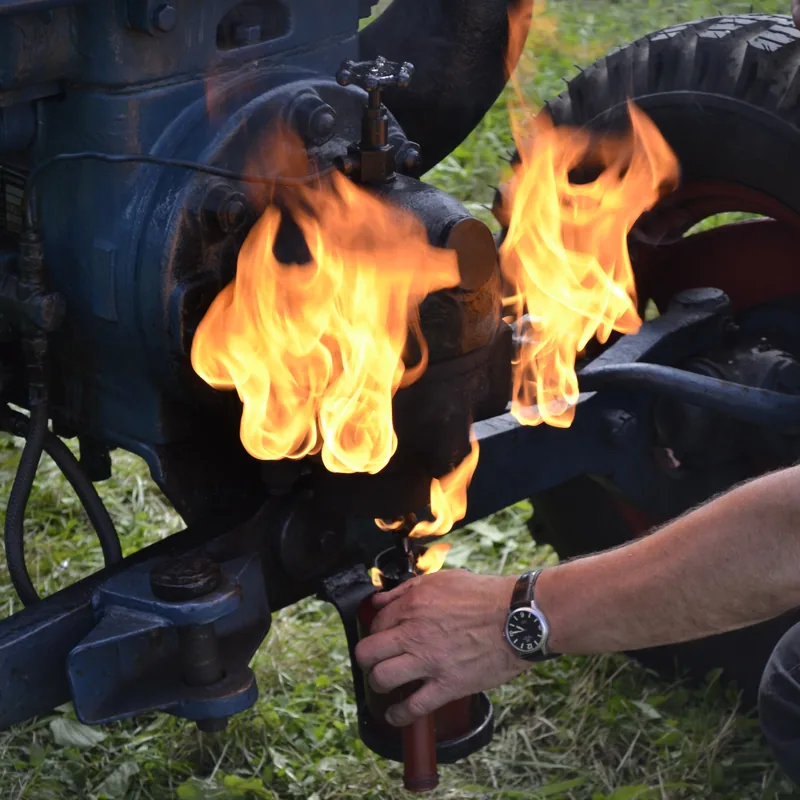
The museum does not, on that catalogue page, use the word “blowlamp.” A later photograph, taken in August 2011, shows a Lanz Bulldog being started by heating the hot bulb with a lamp, flames around the cylinder. The picture is a modern demonstration of the method, and that is how it is captioned. It is still one of the least likely sights in farm machinery: a person calmly setting fire to the side of a tractor so that it will run.
A tractor that ran on fuel cells
In October 1959, near West Allis, Wisconsin, Allis-Chalmers demonstrated a fuel-cell tractor. The Smithsonian National Museum of American History holds it as object AG.76A8. The museum says it plowed alfalfa with a double-bottom plow; that it had 1,008 cells, in 112 units of nine, arranged in four banks; and that a 20-horsepower DC motor did the work. Research, the museum says, had begun in 1951. The tractor was a gift of Allis-Chalmers, and it is currently not on view. [source]
It did not replace the diesel tractor. It remains something rarer: a working field machine from 1959 whose engine was, in effect, a chemistry set on wheels, now in one of the world’s great museums — and, at the time of writing, waiting in store rather than on the gallery floor.
Dan Albone’s Ivel, 1902
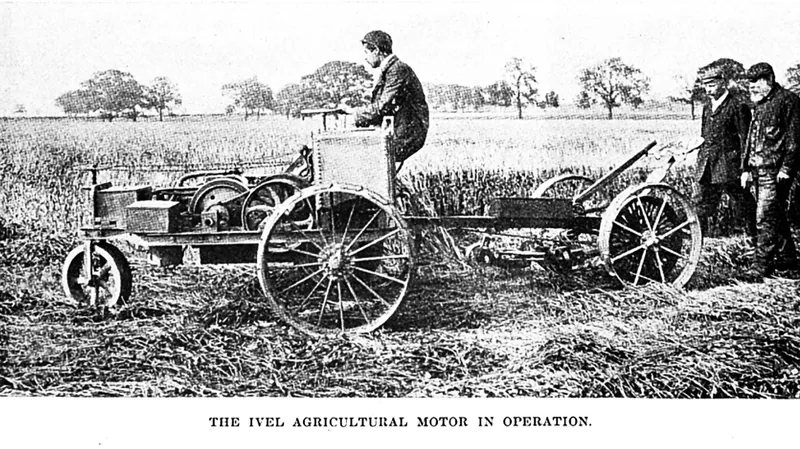
The Science Museum Group’s object 1920-130 is an Ivel agricultural tractor of 1902, designed by Daniel Albone at Biggleswade. The museum believes it to be the first production tractor built by Ivel, and the first British internal-combustion-engine-powered light agricultural tractor. [source]
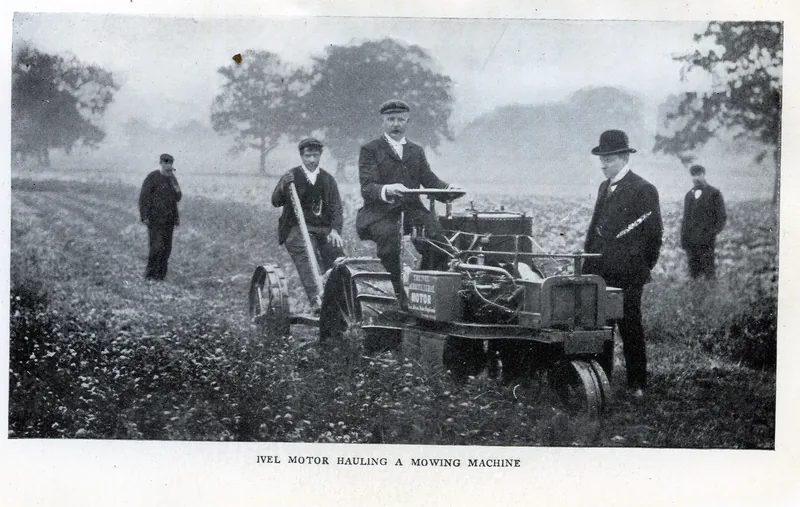
A period photograph in Motor Age, 14 August 1902, and a 1904 plate of an Ivel hauling a mowing machine, show a light, almost delicate machine — three wheels, a visible engine, a man sitting in the open. It is not a traction engine, and it is not yet a grey Fergie. It is the moment a British farm motor starts to look like a tractor.
The Black Tractor of 1933
Ulster Transport Museum records that the Ferguson Black was born in 1933 in Northern Ireland, and was the first tractor to fully incorporate the Ferguson System. [source] It is the missing link, in official museum wording, between Ferguson’s early hitch work and the later grey machines built with Ford and then at Banner Lane.
Where a particular surviving Black Tractor is displayed can change with loans and exhibitions. This site does not assert a current public location.
Tractor England, and an engine from Detroit
MERL’s gallery guide says TE stood for Tractor England. [source] The catalogue description of the museum’s own TE20, object 80/68, says it was probably manufactured in 1948, built by the Standard Motor Company at Banner Lane, Coventry, with a Continental Motors engine imported from Detroit because the plant was not then equipped to build engines. [source]
A classic British tractor, then, with an American heart, built in a factory better known for cars. The nickname “grey Fergie” hides a rather more international machine.
A clockwork tractor, for when a field is too big
MERL also keeps a Ferguson demonstration model, object 2014/16/1-8, dated circa 1949–1951. The catalogue says the clockwork model was designed to show how the three-point linkage worked, without a full-scale demonstration. [source]
There is something almost tender about that official sentence. The invention that transformed a tractor from a mechanical horse into a field machine was also, at least once, wound up like a toy so that people could see it clearly.
A British cousin of the Lanz Bulldog
The Science Museum Group’s Lanz catalogue entry notes that Marshall of Gainsborough built a related British version, described there as a full diesel. [source] It is an easy connection to miss: a German hot-bulb multi-fuel design, born of a fuel shortage, with a British relation from a firm already known for agricultural machinery. The museum’s wording is the warrant for the link; this site does not add a production history the catalogue page does not give.
Ansel Adams and a Ford-Ferguson 9N
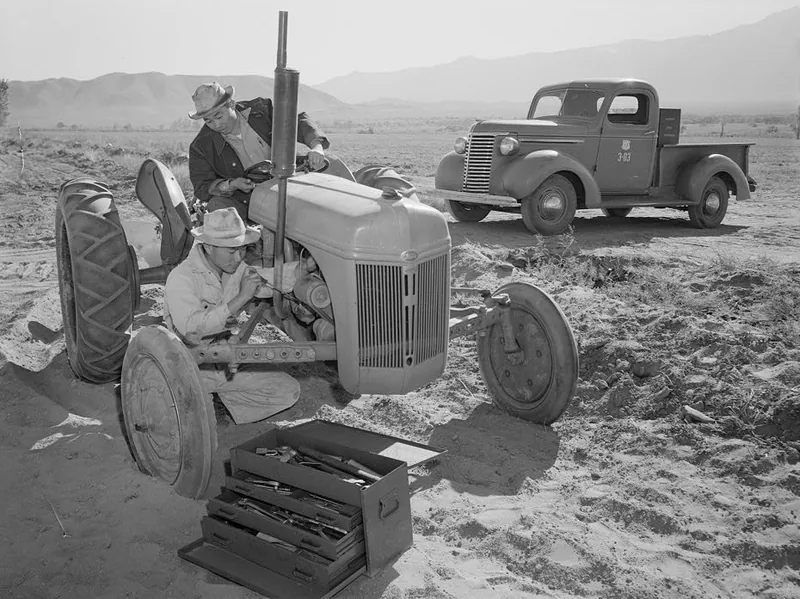
Around 1943, Ansel Adams — the photographer most people know for Yosemite, not for farmyards — photographed a Ford-Ferguson 9N being repaired. The Commons file, from the Library of Congress, names the driver as Benji Iguchi and the mechanic as Henry Hanawa, and notes that the tyres had been moved outward to drive between rows of crops.
The 9N is one of the American Ferguson-system tractors from the handshake years, 1939 to 1946 in MERL’s wording. [source] The photograph is a reminder that those machines were already ordinary working tools, even as their makers’ agreement was heading toward court — and that a great landscape photographer once stopped to watch one being fixed.
Enjoyed the tractor?
No pop-ups. No intrusive advertising. Just interesting stuff. A little support helps the next farmyard site get built.